
Why You’ll Love This French Baguette
Imagine pulling a warm, crusty French baguette straight from your oven, filling your kitchen with that irresistible aroma. This recipe is perfect for anyone eager to try baking at home, offering simple steps that lead to a delightfully crisp crust and airy texture. You’ll find French baguette making it rewarding for busy parents, baking enthusiasts, and even students looking for an easy weekend project.
This recipe stands out due to its ease of preparation, using just a few basic ingredients and straightforward methods that fit into any schedule. Health benefits come from the wholesome components like flour and water, which provide essential carbs and fiber to support daily energy needs. Its versatility means you can tweak it for different tastes, making it ideal for diet-conscious folks or those hosting gatherings.
Beyond the basics, this French baguette delivers a distinctive flavor profile that’s both authentic and approachable. The crisp outer layer and soft inside bring a touch of traditional baking into your routine, perfect for pairing with meals or enjoying on its own. Whether you’re a food enthusiast or a working professional, this bread adds a special touch to everyday life, encouraging you to experiment and enjoy the process.
As you dive into this guide, remember that perfecting a French baguette takes a bit of practice, but the results are worth it. For more tips on getting started, check out our baking basics guide on the blog. This approach not only simplifies baking but also helps build confidence in the kitchen for all skill levels.
Key Benefits at a Glance
- Quick and simple prep with minimal tools needed.
- Nutrient-rich ingredients that support a balanced diet.
- Easy adaptations for vegan or gluten-free options.
- A flavorful result that enhances any meal.
Jump to:
- Why You’ll Love This French Baguette
- Key Benefits at a Glance
- Essential Ingredients for French Baguette
- Main Ingredients List
- How to Prepare the Perfect French Baguette: Step-by-Step Guide
- Shaping and Proofing the Dough
- Baking and Cooling
- Dietary Substitutions to Customize Your French Baguette
- Mastering French Baguette: Advanced Tips and Variations
- How to Store French Baguette: Best Practices
- FAQs: Frequently Asked Questions About French Baguette
- What ingredients do I need to make a traditional French baguette?
- How long should I ferment baguette dough in the refrigerator?
- Can I bake baguettes without a baking stone?
- What’s the best way to score baguettes before baking?
- How can I keep my baguette crust crispy after baking?
- French Baguette
- Ingredients
- Instructions
- Last Step:
- Notes
- Nutrition
- Did you make this recipe?
Essential Ingredients for French Baguette
Gathering the right ingredients is the first step to crafting a delicious French baguette. Using precise measurements ensures your dough turns out just right, so grab a kitchen scale for accuracy. This section lists all the items you’ll need, based on a time-tested recipe that focuses on quality and simplicity.
Main Ingredients List
- 500 grams all-purpose flour (about 3 1/2 cups using the ‘scoop and swipe’ method)
- 360 grams water (about 1 1/2 cups plus 1 tablespoon)
- 10 grams salt (about 2 teaspoons)
- 3 grams instant yeast (about 1 teaspoon, also called quick rise or rapid rise yeast)
- 25 grams honey (about 1 tablespoon, optional for subtle sweetness)
These ingredients form the foundation of your French baguette, creating a dough that’s easy to work with and full of flavor. For special dietary needs, consider simple swaps like gluten-free flour blends to keep things inclusive. Always measure carefully to achieve the best texture and rise.
How to Prepare the Perfect French Baguette: Step-by-Step Guide
Making a French baguette at home is an adventure that brings professional-quality bread to your table. Start by combining all ingredients in a bowl and letting the mixture rest for 15 minutes, which helps the flour absorb the water and begin the gluten development process. Over the next 1 1/2 hours, perform three sets of stretch and folds, turning the dough upside down after each set to build strength and structure without needing a mixer.
After the folds, cover the bowl and refrigerate the dough overnight for 12-14 hours; this slow fermentation step is key for developing deep flavor and a superior texture in your French baguette. Once chilled, remove the dough from the fridge, turn it onto a lightly floured surface, and divide it into three equal portions. Shape each into a rectangle, cover them, and let them rest for 45-60 minutes to relax the dough and make it easier to form.
Shaping and Proofing the Dough
Next, stretch each rectangle slightly and fold it into a cylinder, sealing the seams carefully to avoid degassing the dough, then roll gently to about 14-15 inches long. Place the shaped cylinders on a lightly floured baker’s couche or a mix of regular and rice flour to prevent sticking during proofing. Cover and let them proof at room temperature for 30-60 minutes, checking readiness by gently poking the dough it should spring back slowly.
For baking, preheat your oven to 500°F (260°C), positioning a baking stone in the upper half and a pan with hot water and a rolled kitchen towel on the lower rack to create steam, which is essential for that signature crust. Transfer the proofed baguettes to parchment paper, seam side down, dust off excess flour, and score them with three swift, firm cuts at a 30-40 degree angle, about 1/4 to 3/8 inch deep to promote proper oven spring.
Baking and Cooling
Slide the parchment with the baguettes onto the preheated baking stone, reduce the temperature to 475°F (246°C), and bake for 15 minutes with steam for a crisp exterior. Then, remove the water pan, rotate the baguettes 180 degrees for even browning, lower the heat to 450°F (232°C), and bake for another 15 minutes until they turn deep golden brown. Finally, let the baguettes cool completely on a wire rack before slicing, allowing the flavors to settle.
This method ensures your French baguette has the ideal crust and texture, making it a hit for any occasion. If you’re curious about authentic techniques, visit the Authentic French Baguettes guide for more insights. Remember, factors like oven variations might require slight adjustments to times and temperatures for the best results.
| Step | Description | Tips |
|---|---|---|
| 1-3: Mixing and Fermentation | Combine ingredients and do stretch and folds, then refrigerate. | Use wet hands if dough is sticky. |
| 4-6: Shaping and Proofing | Divide, shape, and proof the dough. | Let rest to relax for better handling. |
| 7-11: Baking | Preheat, score, and bake with steam. | Monitor for golden brown finish. |

Dietary Substitutions to Customize Your French Baguette
Adapting your French baguette recipe is simple and fun, allowing you to meet various dietary needs without losing that classic taste. For instance, swap traditional flour with gluten-free blends from rice or almond to suit those with sensitivities. You can also use plant-based yeast options to keep things vegan-friendly, ensuring everyone enjoys a fresh loaf.
Adding flavors like herbs or roasted garlic can enhance your bread while keeping it light. Consider using dairy-free oils in place of butter for a healthier twist, or mix in sun-dried tomatoes for a burst of taste. These changes make your French baguette versatile for different meals and preferences.
As a home baker, I’ve found that small tweaks, like incorporating rosemary, can turn a basic baguette into something special for family dinners.
Mastering French Baguette: Advanced Tips and Variations
Taking your French baguette to the next level involves a few pro techniques, like using a baking stone for better heat retention and creating steam in the oven for an extra crispy crust. Experiment with flavors by adding olives or nuts to the dough for unique twists that surprise your guests. Presentation matters too, so try slicing the baguettes diagonally and pairing them with fresh herbs or dipping oils.
For busy days, prepare the dough ahead and refrigerate it overnight up to 48 hours to enhance flavor and save time. Adjust hydration levels based on your experience; beginners might start lower for easier handling. These tips, drawn from real baking practices, help you refine your skills and enjoy consistent results.
How to Store French Baguette: Best Practices
Keeping your French baguette fresh is key to enjoying its texture over time. Store it in a sealed plastic bag or bread box for up to 2 days at room temperature to maintain that crisp crust. For longer storage, wrap it tightly and freeze for up to 3 months, making it easy to have homemade bread on hand.
When you’re ready to eat, reheat frozen baguettes in a 350°F oven for 5-10 minutes to bring back the crunch. For meal prep, slice them before freezing to simplify portioning, ensuring your French baguette stays delicious for future use.

FAQs: Frequently Asked Questions About French Baguette
What ingredients do I need to make a traditional French baguette?
A classic French baguette requires just four simple ingredients: flour, water, yeast, and salt. The flour is usually bread flour for better gluten development, but all-purpose flour can also work. No added fats or sugars are needed, though some recipes may include a small amount of honey to slightly soften the dough. These basic ingredients combined with proper fermentation and baking techniques create the baguette’s characteristic crust and open crumb.
How long should I ferment baguette dough in the refrigerator?
Baguette dough can be cold fermented in the refrigerator for 12 to 48 hours to develop flavor and improve texture. Fermenting longer than 48 hours risks overproofing and a decline in dough quality. After cold fermentation, shape and proof the dough at room temperature before baking. If you’re short on time, you can ferment at room temperature, but the flavor will be less complex.
Can I bake baguettes without a baking stone?
Yes, you can bake baguettes without a baking stone by using alternatives like baking steel, stacked baking trays, unglazed tiles, or a cast iron griddle. These materials help retain heat and promote good oven spring. If none of these are available, place the dough on a preheated heavy baking sheet. Remember to add steam during the first part of baking to develop a crisp crust.
What’s the best way to score baguettes before baking?
Use a sharp bread lame or a very sharp razor blade to make 3 to 5 quick, shallow slashes along the top of each baguette. Scoring should be done with a swift motion at a 30-45 degree angle to help the dough expand properly in the oven and form the traditional pattern. Proper scoring encourages oven spring and creates an attractive crust.
How can I keep my baguette crust crispy after baking?
To maintain a crispy crust, let the baguette cool completely on a wire rack before storing. Avoid wrapping it in plastic while warm, as this traps moisture and softens the crust. Store the bread in a paper bag or loosely wrapped cloth to allow air circulation. If the crust softens, refresh it by placing the baguette in a preheated oven at 350°F (175°C) for about 5-10 minutes before serving.
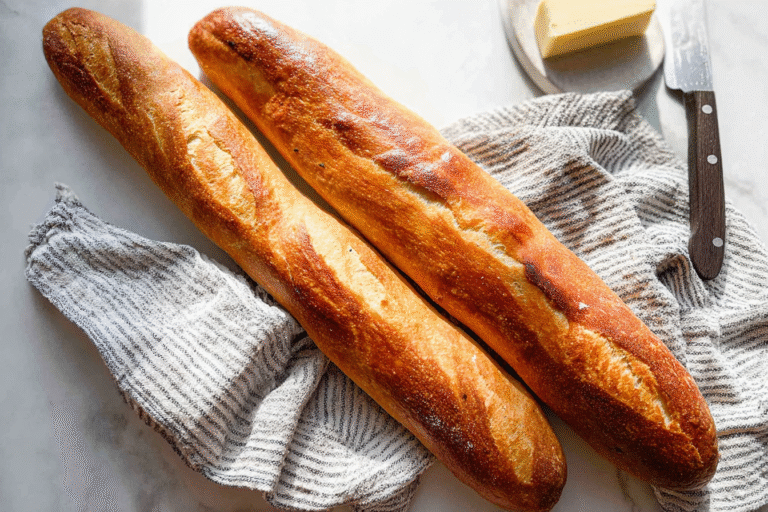
French Baguette
🥖 Master the art of perfect French baguettes with a simple, step-by-step recipe that yields a crisp crust and ideal texture.
🌟 Enjoy the rewarding process of slow fermentation that enhances authentic flavor and creates bakery-style results at home.
- Total Time: 13 hours 45 minutes to 15 hours 45 minutes
- Yield: 3 baguettes 1x
Ingredients
500 grams all-purpose flour
360 grams water
10 grams salt
3 grams instant yeast
25 grams honey
Instructions
1-Start by combining all ingredients in a bowl and letting the mixture rest for 15 minutes, which helps the flour absorb the water and begin the gluten development process. Over the next 1 1/2 hours, perform three sets of stretch and folds, turning the dough upside down after each set to build strength and structure without needing a mixer.
2-After the folds, cover the bowl and refrigerate the dough overnight for 12-14 hours; this slow fermentation step is key for developing deep flavor and a superior texture in your French baguette. Once chilled, remove the dough from the fridge, turn it onto a lightly floured surface, and divide it into three equal portions. Shape each into a rectangle, cover them, and let them rest for 45-60 minutes to relax the dough and make it easier to form.
3-Next, stretch each rectangle slightly and fold it into a cylinder, sealing the seams carefully to avoid degassing the dough, then roll gently to about 14-15 inches long. Place the shaped cylinders on a lightly floured baker’s couche or a mix of regular and rice flour to prevent sticking during proofing. Cover and let them proof at room temperature for 30-60 minutes, checking readiness by gently poking the dough it should spring back slowly.
4-For baking, preheat your oven to 500°F (260°C), positioning a baking stone in the upper half and a pan with hot water and a rolled kitchen towel on the lower rack to create steam, which is essential for that signature crust. Transfer the proofed baguettes to parchment paper, seam side down, dust off excess flour, and score them with three swift, firm cuts at a 30-40 degree angle, about 1/4 to 3/8 inch deep to promote proper oven spring.
5-Slide the parchment with the baguettes onto the preheated baking stone, reduce the temperature to 475°F (246°C), and bake for 15 minutes with steam for a crisp exterior. Then, remove the water pan, rotate the baguettes 180 degrees for even browning, lower the heat to 450°F (232°C), and bake for another 15 minutes until they turn deep golden brown. Finally, let the baguettes cool completely on a wire rack before slicing, allowing the flavors to settle.
Last Step:
Please leave a rating and comment letting us know how you liked this recipe! This helps our business to thrive and continue providing free, high-quality recipes for you.Notes
⚖️ Use a kitchen scale for accurate measurements as cup volumes can vary.
🔥 Thick baking stones or similar alternatives provide essential stored heat for optimal oven spring.
🌾 A baker’s couche dusted with rice and regular flour prevents sticking during proofing.
- Prep Time: 15 minutes
- Resting and Fermentation: 13 to 15 hours
- Cook Time: 30 minutes
- Category: Bread
- Method: Baking
- Cuisine: French
- Diet: Vegetarian
Nutrition
- Serving Size: 1 slice (based on 12 servings from total dough)
- Calories: 158 kcal
- Sugar: 2 g
- Sodium: 326 mg
- Fat: 1 g
- Saturated Fat: 1 g
- Unsaturated Fat: 0 g
- Trans Fat: 0 g
- Carbohydrates: 33 g
- Fiber: 1 g
- Protein: 4 g
- Cholesterol: 0 mg